
Valentine V1 GEN2 ®
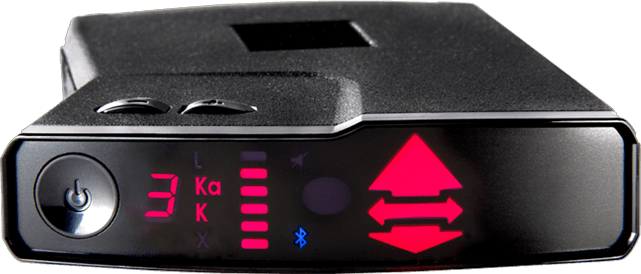
Radar and laser detection with directional arrows — front and rear. A magnesium cased instrument with a patented radar-seeking engine, K-Verifier false-alert filtering, built-in Bluetooth 5.0, and free over-the-air firmware updates.
Sold direct. No middleman markup. · 30-Day Money-Back Guarantee


Sold direct from Valentine — no retail markup
Free over-the-air firmware updates
30-day money-back guarantee
Gen1 upgrade program
Invented radar location in 1991
Six problems, solved.
Each one names the technology that solves it — problem, engineering decision, result.
The warning that arrives first.
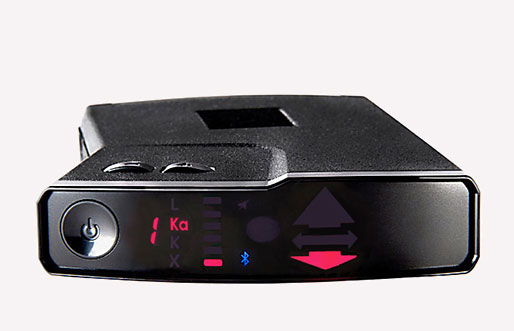
On an open highway, the detector that warns you first is the one that gives you time to react. V1 GEN2 uses a low-noise amplifier (LNA) to pull in fainter, more distant signals, feeding a patented SAW-D2L processing stage adapted from a concept used by military CHIRP radars. The system also features a patented antenna design with a well-balanced on-axis and off-axis coverage and sweep rate that is 15-40 times more than the competition. The results are substantial range increase, exceptional around the corner coverage, and best protection against intermittent signals.

Completely undetectable.
Many detectors leak their own local-oscillator output, which radar-detector-detectors are built to find. The V1 GEN2 has a fast scan rate, and the LNA acts as a one-way valve, trapping that output inside the magnesium case before it can escape. The result is a detector that runs completely undetectable.

Alerts that carry weight.
Nearly every new car around you has a blind-spot monitor (BSM), and shopping centers are full of automatic door openers. Both broadcast on K band, and both trigger lesser detectors constantly. On the highway, especially on long trips, and when travelling on unfamiliar roads, the detector with the best BSM filter will give you the quietest ride. V1 GEN2 includes K-Verifier, which sorts those signatures from law-enforcement signals. The result is fewer nuisance K-band alarms, so the alerts you hear carry weight. Our solution for false alarms caused by stationary sources is that V1 GEN2 has analyzer modes, automatic muting, low speed muting, sensitivity adjustment options to deal with repetitive false alerts and the SAVVY®* for low speed muting.
*SAVVY is not compatible with all vehicles. Click here for compatibility details.
You see the threat location.
Mike Valentine's team invented directional radar location in 1991 — the arrows that tell you whether a signal is ahead, beside, or behind. V1 GEN2 scans all the way around the car: a radar antenna and laser sensor face forward, and a second antenna-and-eye set watches through the rear glass. The result is that you don't just hear that a threat exists. You see where it is — even when several sources are active at once.

Built for what enforcement uses now.
Photo radar is spreading, and newer 3D, 3DHD, and 4D K-band units are designed to be difficult to catch. V1 GEN2 now detects all three.
About photo radar →
Users have different needs.
No two drivers want the same alerts. V1 GEN2 is deeply programmable — turn individual radar bands on or off, choose among logic modes, set display brightness, and tune how and when it mutes, all from the V1connection app. Set it up once for the way you drive, and it stays that way. The open-source API allows users to add extra functionality through third-party apps.
Engineered to catch what the others miss.
Sold direct. No middleman markup. · 30-Day Money-Back GuaranteeWhat Our Customers Say
Valentine's no-obsolescence policy means the detector updates as technology evolves — a long-term investment, not something you replace in a few years.
I've used Valentine detectors for over 40 years — now the Gen2. Four decades, and not one speed-related ticket.
Superior range — it picks up faint blips far ahead with phenomenal off-axis detection. The magnesium case and crisp arrows beat anything else out there.
Built-in Bluetooth, and a detector that doesn't go obsolete.
Built-in Bluetooth 5.0 connects V1 GEN2 to your Apple or Android phone and tablet. The free V1connection app streams live threat data, handles programming, and delivers firmware upgrades over the air.
That last part is the one that matters most over time. When enforcement technology changes, V1 GEN2 is updated in software. You apply the update in minutes from your phone — you do not ship the unit anywhere and wait. It is not a subscription, and it is not a device that ages out the moment the next threat appears.
The full datasheet.
| Spec | Detail |
|---|---|
| Product | Valentine One V1 GEN2 (Item 20020) |
| Type | Radar and laser detector |
| Radar bands | X, K, Ka — including 3D, 3DHD, and 4D K-band photo radar |
| Laser (LiDAR) | Front and rear |
| Directional arrows (Radar Locator) | Ahead, Beside, Behind |
| Front detection | Radar and laser |
| Rear detection | Radar and laser |
| False-alert filtering | K-Verifier (blind-spot radar, automatic door openers) |
| Signal processing | Patented SAW-D2L |
| Range technology | Low-noise amplifier (LNA) |
| Stealth | Completely undetectable to radar-detector-detectors |
| Bluetooth | Built-in 5.0 |
| App | V1connection, the app (iOS and Android) — free |
| Firmware updates | Free, over-the-air |
| Case | Magnesium |
| Dimensions | 4.6 in. L × 3.8 in. W × 1.0 in. H |
| Weight | 6.5 oz. |
| Origin | Built in Cincinnati, Ohio, USA |
| Price | $599.00 plus shipping |
| Guarantee | 30-day money-back |
What comes with V1 GEN2?
- Valentine One Gen2 radar detector
- Quick Start Guide
- Windshield mount
- Visor mount
- Coiled power cord (2 ft., stretches to 8 ft.)
- Straight power cord (8 ft.)
- Lighter adapter
- Direct-wire adapter
- Wiring harness connector
- Spare fuse
- Spare suction cups
Frequently asked questions.
The V1 GEN2 isn't just competitive, it's in a class by itself. Its patented SAWD2L technology scans radar bands 192 times per second, compared to 5–13 times per second on competing units, resulting in superior early warning, pattern detection, and BSM filtering without relying on risky block or notch features. Front and rear LNAs on all bands, FPGA-based parallel signal processing instead of sequential DSP, and an all-new patented antenna deliver the longest detection range and widest coverage in independent testing. The magnesium housing, precision three-point mount, and an open API reflect a level of engineering no plastic-housed competitor matches. At $599, it outperforms units costing $150–200 more. While others ship from the factory with bands segmented and omit an antenna or LNA for rear coverage just to keep up, the V1 GEN2 delivers full coverage with no compromises.
The V1 GEN2 is ready to protect you the moment you plug it in, no configuration required. Default settings are optimized for real-world performance, and for those who want more control, the free V1connection app provides deep customization including sensitivity adjustments, band settings, and custom profiles that can be pushed to the detector with a tap. Unlike competitors that require a Wi-Fi hotspot to update, the V1 GEN2 receives firmware updates wirelessly over Bluetooth, keeping your unit current without any hassle. The optional SAVVY* accessory plugs into your OBD2 port for ignition-switched power and reliable low-speed muting that works even in parking garages, where GPS-based systems on competing units fail. Whether you prefer simplicity or full control, the V1 GEN2 adapts to you.
The V1 GEN2 is the only radar detector that consistently retains its value. While other brands are frequently discounted and replaced every few years, the V1 GEN2 is engineered to stay relevant for decades through firmware updates and a factory upgrade program. Software updates are free, and the open API means a growing ecosystem of third-party apps continues to add capability over time. The V1 GEN2 is backed by Valentine Research's industry-leading warranty and, if it isn't right for you, it may be returned on the 30-day, money-back guarantee. When you factor in resale value, avoided tickets, and longevity, the V1 GEN2 is the most cost-effective detector on the market.
Radar detectors are legal to use in passenger vehicles except in Virginia and in Washington, DC. Federal law bans their use in commercial vehicles and on military bases. Some states restrict mounting anything on the windshield, even where the detector itself is legal, so a visor or dash mount may be required. Laws may change, so confirm the current rule where you will be driving. This is general information, not legal advice.
Modern vehicles equipped with blind-spot monitoring (BSM) transmit K-band radar, the same band police use, making BSM interference the most common source of false alerts. Since these signals come from moving vehicles, GPS filtering is useless here; the detector with the best BSM filter wins. V1 GEN2's K-Verifier identifies BSM signals by analyzing their modulation pattern, filtering interference without blocking or narrowing the police band the way competitors do, a practice that creates dangerous blind spots in coverage.
In urban areas, supermarket automatic doors are the main cause of false alarms because they operate on police X and K bands. The most common solutions for false alarms caused by stationary sources are GPS lockout, automatic muting, and sensitivity adjustments. GPS lockout has its limitations and risks: it will not help when driving in unfamiliar areas or travelling out of town because it has to see the signal at least three different times before it learns to filter it, and it risks suppressing police radar operating nearby because the lockout window applied for each frequency filtered is 10-35 MHz wide. V1 GEN2's Logic and Advanced Logic modes intelligently suppress weak, short-duration signals before they become a nuisance. V1 GEN2’s Advanced Auto Mute and low-speed muting via the optional SAVVY* accessory (which works reliably in parking garages where GPS-based systems fail) handle stronger stationary false alerts. Sensitivity adjustments, the V1connection app, and third-party apps provide additional fine-tuning for city driving.
Sensitivity and reactivity are competing demands in radar detection. Superheterodyne receivers must sweep slowly across radar bands to detect weak, distant signals buried in noise. But a slower sweep means the detector may completely miss a short-duration or rapidly changing signal like instant-on or modulated pattern from 3D/4D photo radar. Faster sweeps improve reactivity but typically sacrifice sensitivity.
V1 GEN2's patented SAWD2L technology resolves this tradeoff by scanning each band from both directions 192 times per second, while maintaining exceptional sensitivity and resolution. Competing units manage 5–13 scans per second, and their performance degrades further when optional features like photo radar detection are enabled. V1 GEN2's performance is unchanged regardless of which features are active.
In Car and Driver's independent testing, V1 GEN2 posted the longest straight-line detection range and the widest off-axis coverage in the 90-degree corner test, best in class on both measures.
V1 GEN2's RF receiver resolution is a key feature noted by third-party app developers and the main reason why GPS lockout feature implemented in smartphones is far more superior than ones built-in. Because the signal from automatic doors is unstable, the GPS lockout window is normally 10-20 MHz wide. If a second signal is detected in a lockout window, V1 GEN2 is most likely to identify it thus reducing the risks associated with GPS filtering. Receiver resolution can also make a difference when approaching a speed trap with two officers both running a Stalker radar (one transmitting 34.710 and the other transmitting 34.720 GHz).
V1 GEN2 directional arrows tell you where a threat is, not just that one exists. A detector that only beeps leaves you guessing whether the source is ahead, behind, or beside you. The Radar Locator points to each signal, ahead, beside, or behind, which is the context that lets you read a situation quickly when several sources are active at once. Valentine invented directional radar location in 1991 and has refined it across every generation since.
V1 GEN2 detects laser and all radar bands from the front and the rear. A radar antenna and laser sensor face forward, and a second antenna-and-sensor set watches through the rear glass, so a threat approaching from behind is treated as seriously as one ahead. The Radar Locator arrows then show the direction of each signal, so you always know where a threat sits relative to your car.
X, K, and Ka are the three radar bands police use, and they differ in both threat level and false-alert risk. X band is the oldest and now rare in most areas. K band is widely used by police but is also the band used by automatic doors and the blind-spot and collision-avoidance systems (BSM) in nearly every new vehicle, making it the largest source of nuisance alerts today. Ka band is where most modern police radar operates, so long-range Ka detection is the capability that matters most.
V1 GEN2 is the only detector that also covers Ku band, a radar band used for speed enforcement in parts of Europe and by certain speed cameras, providing protection no competitor offers.
On laser, V1 GEN2 leads the category. It is the only detector with two fully independent front and rear optical sensors, delivering true 360-degree laser detection. Competing units route rear laser signals through a light pipe mounted on the top of the detector, a design compromise that limits placement options and undermines both sensitivity and coverage, despite "360-degree laser" marketing claims.
Full coverage claims deserve scrutiny. Some competitors advertise dual-LNA and triple-antenna designs, yet have no rear antenna for X band and no LNA for rear K/Ka detection, leaving you unprotected. Others cap Ka detection at 35.7 GHz rather than the full 36.0 GHz, and ship from the factory with Ka band segmented, creating gaps in coverage to artificially boost performance numbers. V1 GEN2 covers every band, front and rear, all the way to 36.0 GHz, with no segmentation required and no corners cut.
Yes, when activated in the app. V1 GEN2 detects 3D, 3DHD, and 4D K-band photo radar, which are the newer automated systems designed to be difficult for detectors to catch. Photo radar is spreading across more jurisdictions, which is why current detection of all three types matters rather than detection of older formats alone. Valentine's About Photo Radar page covers the threat in more detail.
Mount it high and centered, just below the rearview mirror, with a clear forward view and the rear antenna's line of sight through the back glass unobstructed. Avoid the metallic or heavily tinted bands some windshields carry near the edges, which can weaken signals. In states that restrict windshield mounting, use the included visor mount instead. Placement affects both detection range and rear-antenna performance, so it is worth getting right.
The V1 GEN2 mounts to the windshield via its precision three-point contact mount, which is low-profile, rattle-free, and more secure than the sticky cup mounts found on competing units. Another option is aftermarket mounts that allow you to attach the detector to the rearview mirror stem. From there, you have three power options depending on your preference.
The standard power cord + lighter plug adapter plugs into any 12v accessory outlet for immediate use. For a cleaner, permanent installation, a hardwire adapter connects directly to the fuse box, providing ignition-switched power so the detector turns on and off with the vehicle.
The optional SAVVY* accessory plugs into your vehicle's OBD2 port, no fuse box required, and serves two purposes: it provides ignition-switched power like a hardwire adapter, and it enables reliable low-speed muting by reading vehicle speed directly from the ECU. Unlike GPS-based low-speed muting on competing units, SAVVY* works instantly and reliably in parking garages where GPS signal is unavailable.
For newer vehicles equipped with USB-C ports but no traditional 12v outlet, Valentine Research offers a USB power adapter so you're never without a connection option.
Detection range depends on conditions more than on any single number. Terrain, line of sight, weather, and the type of radar all change how early a warning arrives. V1 GEN2 is engineered for range superiority over the original V1, using a low-noise amplifier to pull in fainter, more distant signals and patented SAW-D2L processing to sort them quickly, with the largest gains on Ka band. In open, line-of-sight highway conditions it warns earlier than the platform it replaces.
Yes. Built-in Bluetooth 5.0 connects V1 GEN2 to Apple and Android phones and tablets. The free V1connection app streams live threat data, handles programming, and delivers firmware updates over the air. The app is where you adjust settings, see detailed signal information, and keep the unit current as enforcement technology changes, with no separate hardware required for the connection.
New enforcement technology is addressed in firmware, delivered free and over the air through the V1connection app. You apply an update from your phone in a few minutes rather than shipping the unit anywhere and waiting. There is no subscription. This is the direct answer to the most common long-term worry about a detector at this price: it is built to stay current rather than age out.
The V1 GEN2 is $599.00 plus shipping, sold direct from Valentine, with no retail markup. The price includes the detector and its full accessory set, free firmware updates over the air, and a 30-day money-back guarantee. There is no subscription. Measured against the cost of a single ticket plus the insurance surcharge that follows it, many drivers treat the unit as a one-time cost that pays for itself.
Yes. Every V1 GEN2 includes a 30-day money-back guarantee, so you can test it on your own routes and return it if it is not right for you. Because Valentine sells direct, returns and support go straight through the company rather than a reseller.
Each V1 GEN2 ships with the detector, a Quick Start Guide, a windshield mount, a visor mount, a coiled power cord that stretches from two to eight feet, a straight eight-foot power cord, a lighter adapter, a direct-wire adapter, a wiring harness connector, a spare fuse, and spare suction cups.
Yes. If you already own an original Valentine One, you may qualify for upgrade options to move to the V1 GEN2. The V1 GEN2 offers next level performance with new electronics, K-Verifier filtering, range gains, and built-in Bluetooth. Check the upgrade program to see your options and eligibility before buying a new unit outright.
SAVVY® is not compatible with all vehicles. Click here for compatibility details.
What one ticket actually costs.
A single speeding ticket averages roughly $150 to $300 before insurance gets involved. Add the surcharge an insurer applies over the next three to five years, and one ticket can run past $1,000.
V1 GEN2 costs $599, once. It keeps working — with free firmware updates as enforcement technology changes. Run the math the way you'd run any other purchase, and it pays for itself the first time it earns its keep.
It pays for itself with one ticket.
Sold direct. No middleman markup. · 30-Day Money-Back GuaranteeValentine One V1 GEN2.
Front and rear radar and laser detection. Directional arrows. K-Verifier filtering. Free firmware updates that keep it current. Built in Cincinnati and sold direct.
Sold direct. No middleman markup. · 30-Day Money-Back Guarantee