
About POP Radar
The POP™ mode isn’t error prone; it’s error riddled!
Local ticket writers have been bragging about their new radar; They say it nails detector users without warning.
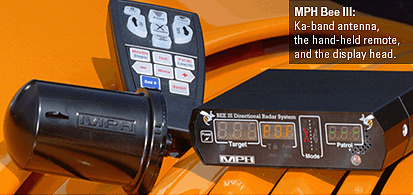
Yes, their MPH Industries model BEE™ III, with its POP™ mode, gave them an advantage for a while. But now V1 has full-time POP Radar Protection on two bands. Yet a problem remains. When operated in its POP mode, those radars also produce erroneous speed readings every time.
Moreover, we believe MPH Industries knows this feature is faulty. Why else would it advise, in the accompanying Operation and Service Manual, as follows:
“A note of caution: Information derived during the POP burst is non-evidential… Citations should not be issued based solely on information derived from the POP burst.”
In actual testing of a BEE III in our laboratory, we quickly learned why MPH Industries is covering itself in the fine print. The POP mode is fundamentally flawed. It consists of a lightning-quick radar burst, over and done with before a radar detector can pick up the signal. We consistently measured the POP duration at 67 milliseconds (that’s 0.067 second).
Unfortunately for accuracy, that burst is over the speed limit for the BEE III’s own internal components.
All traffic radar units rely on a Gunn oscillator to produce a stable, reference frequency for the microwave beam. This reference frequency must be held constant throughout the entire reading. Here’s how radar works: A microwave beam at the reference frequency is transmitted toward the target. The radar unit then compares the reference beam to a reflection of that same beam after it has bounced off a moving vehicle and returns to the radar unit. The difference between the reference frequency and the reflected frequency—known as the Doppler shift—gives the speed of the moving vehicle.
No Gunn oscillator we’ve ever tested can go from “off” to “on” and back “off” again in 67 milliseconds while simultaneously holding its frequency. This is basic physics. To be “on,” electrical current must flow through the oscillator. As the current begins flowing, it inevitably heats the component. While the device’s temperature is changing, so is its frequency. After a second or so under power, the device will reach its constant operating temperature and it will hold steady at its design frequency.
However, during the short cold start from ambient temperature to operating temperature, the device is literally out of control. Component makers don’t even bother to quantify the frequency change—called a start-up chirp in electronic jargon—because Gunn oscillators are designed as steady-state devices; they’re not intended for cold-start use.
What does this start-up chirp mean for ticket accuracy? The answer is really unknowable, because it’s influenced by a number of variables. For example, how far away is the target vehicle? The longer the distance, the greater the error. What’s the target speed? The slower it is, the larger the percent error. Which way is the target moving? The error adds to the speed of vehicles approaching the radar, and subtracts from vehicles heading away.
Clearly, MPH Industries has stepped into foul territory with the POP mode. In its zeal to defeat detector users, it has created a radar unit operating outside the accepted principles of engineering. Then it has tried to paper over its own technical recklessness by advising police operators, sotto voce in an obscure section of the manual, that they can’t use the BEE III’s key selling feature for its plainly intended purpose.
Question Number One: Given the widespread ignoring of manuals, will anyone even read that warning?
Question Number Two: If they read it, will they heed it?
MPH Industries, in its quest for corporate profits, is playing an unconscionable game with its law-enforcement customers. Traffic radar is bought for one reason; it’s a ticket machine. Promising a feature, then telling the police after the sale not to use that feature for writing tickets, is pure bait-and-switch. Moreover, it dangles a temptation, a moral hazard, that threatens to corrupt enforcement. MPH Industries must be compelled to recall all BEE IIIs at once and disable the fundamentally faulty POP mode.